
This is a fictional log from the world of Oksa, where Knowla is an emotion-sensing robot created by designer Nova. I use these stories as design fiction to explore the future of behavior tech and below I connect it to what we’re building at the real Knowla today. This is the beginning, the origin story of the time before Knowla, when young Nova is yet to form her ideas of what technology that truly serves humans look like.
Milla Koivisto, CEO & Chief Narrative Architect
The university courtyard was busy. Scattered around, young adults sat gossiping, eating, and occasionally laughing. Trees and bushes dominated the landscape, and benches designed in half-arches formed natural gathering spots—reminiscent of ancient campfires, optimal for storytelling. The noise was moderate, partially due to the oval, high, see-through roofing, which absorbed some of the sound.
Nova sat on a bench. Her mind, which rarely rested, was now focused on two pigeons courting nearby. With some imagination she could hear a song playing as a soundtrack. In the rhythm of Witchcraft sung by Frank Sinatra, the male bird circled the female. In the chorus he amped up the effort to capture her attention. Nature was cunning, always optimising for life to proceed. Just as the male pigeon was reaching his highest point in the performance, the dance was abruptly ended.
“Nova, check this out!”
The pigeons flew away as two young men approached her. The one speaking was Reeve, Nova’s classmate. He came toward her with something in his hand.
“Give me your wrist.”
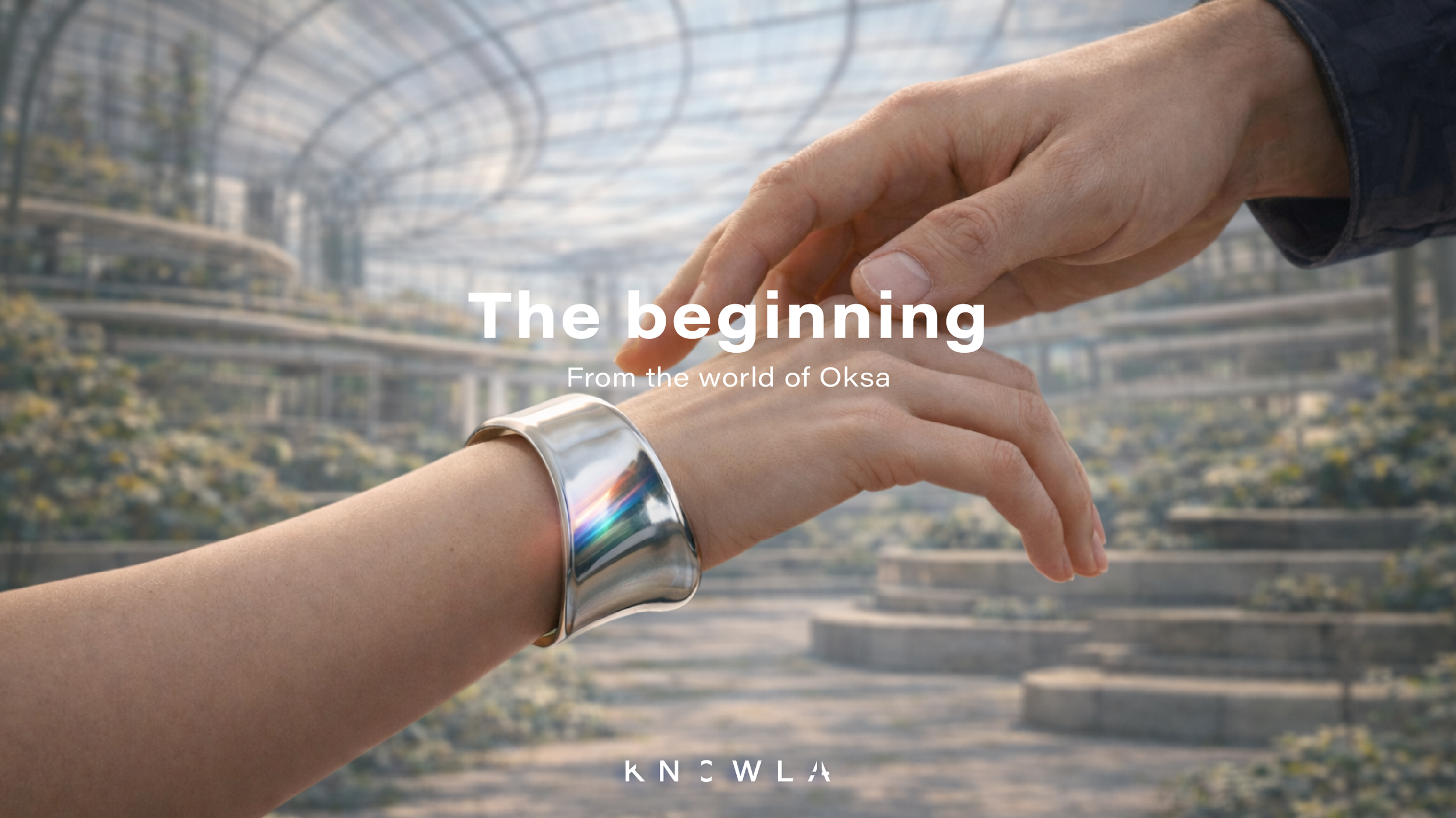
Nova reached out her right hand. Reeve slid a metallic bracelet onto her wrist.
“It’s beautiful. Heavy,” Nova said, and shook her hand once, testing the weight.
The band sat there like a decision. Not jewellery—an instrument. Something that would turn a body into a stream of signals.
Nova didn’t imagine flashing graphs. She imagined baselines. Deviations. Cycles. Signals that returned whether you paid attention to them or not. Weeks when her focus sharpened, and weeks when everything felt heavier—not broken, just different. Her own cycle wasn’t a mystery to her—it was a repeating baseline. It shifted her sleep, her patience, the way thoughts connected. Patterns she often only recognised in hindsight.
She liked patterns. She trusted them.
But patterns alone didn’t change anyone.
“What does it do?” she asked.
“It will change everything!” Reeve said, his face glowing.
Reeve talked fast. Metrics, correlations, dashboards.
“So people can finally see what’s happening inside them,” Reeve said.
Nova looked at the bracelet again.
And then what?
That question—and then what?—is where Knowla begins
A lot of behaviour technology today measures and visualises through charts. It assumes that if people can see enough data about themselves, they’ll change. But humans don’t change because a chart exists.
Knowla is building behaviour technology that turns signals into practical guidance—the layer after measurement. We interpret patterns over time and deliver guidance that actually lands, through design, context, and story.
In simple terms, we work across three layers:
Sense: capture signals from a person and their context
Model: recognise patterns over time (not single moments)
Guide: deliver guidance that fits the moment—timely, predictive, story-based, and pattern-driven
Because knowing your patterns doesn’t change you. Change happens when guidance meets the human system—attention, emotion, and context—at the right time.